About the object: Christine Wagner's stoneware vase has a rough surface and creates a calming atmosphere thanks to its finely coordinated coloring. The object is approx. 37 cm high, 24 cm wide and 8 cm deep. The floor plan of the built vase defines the clear shape. The large designed plates are covered with white engobes made of chalk and kaolin and seem to breathe. A special feature of the vessel is the slit-shaped opening, which picks up on the horizontal line of the step and thus creates a harmonious composition. Reduced to the essentials, Christine Wagner's unique stoneware pieces impress with their pure beauty.
Manufacturing process: The surfaces of Christine Wagner's hand-built stoneware vases have grooved, linear or stamped structures and follow linear patterns. Made from self-mixed, coarse-grained clay from the Westerwald, the grainy structure or stamped pattern is accentuated by the application of white engobes of chalk and kaolin to the dry surfaces. This creates a multi-layered surface effect. The thin application of kaolin with a brush creates a glaze-like effect, like a whitewashed clay wall, and the use of cobalt salt achieves the gray-bluish accent on the light surfaces. Firing in a gas kiln with a reducing flame is essential for the appearance of the vases and objects. By removing the oxygen in the reduction firing at 1280 degrees, Christine achieves a color spectrum of the fired clay from light grey to beige or darker brown tones, depending on the clay mixture.
We offer reliable shipping for our products to various destinations. Here are our shipping options:
Germany:
EU countries:
Switzerland: Information regarding transportation costs to Switzerland can be found here.
Please note that the stated delivery times are estimates and may vary depending on the destination and current circumstances. We are always working to get your orders to you as quickly as possible.
For further information or special inquiries about shipping, please do not hesitate to contact us. to contact. We are happy to answer your questions.
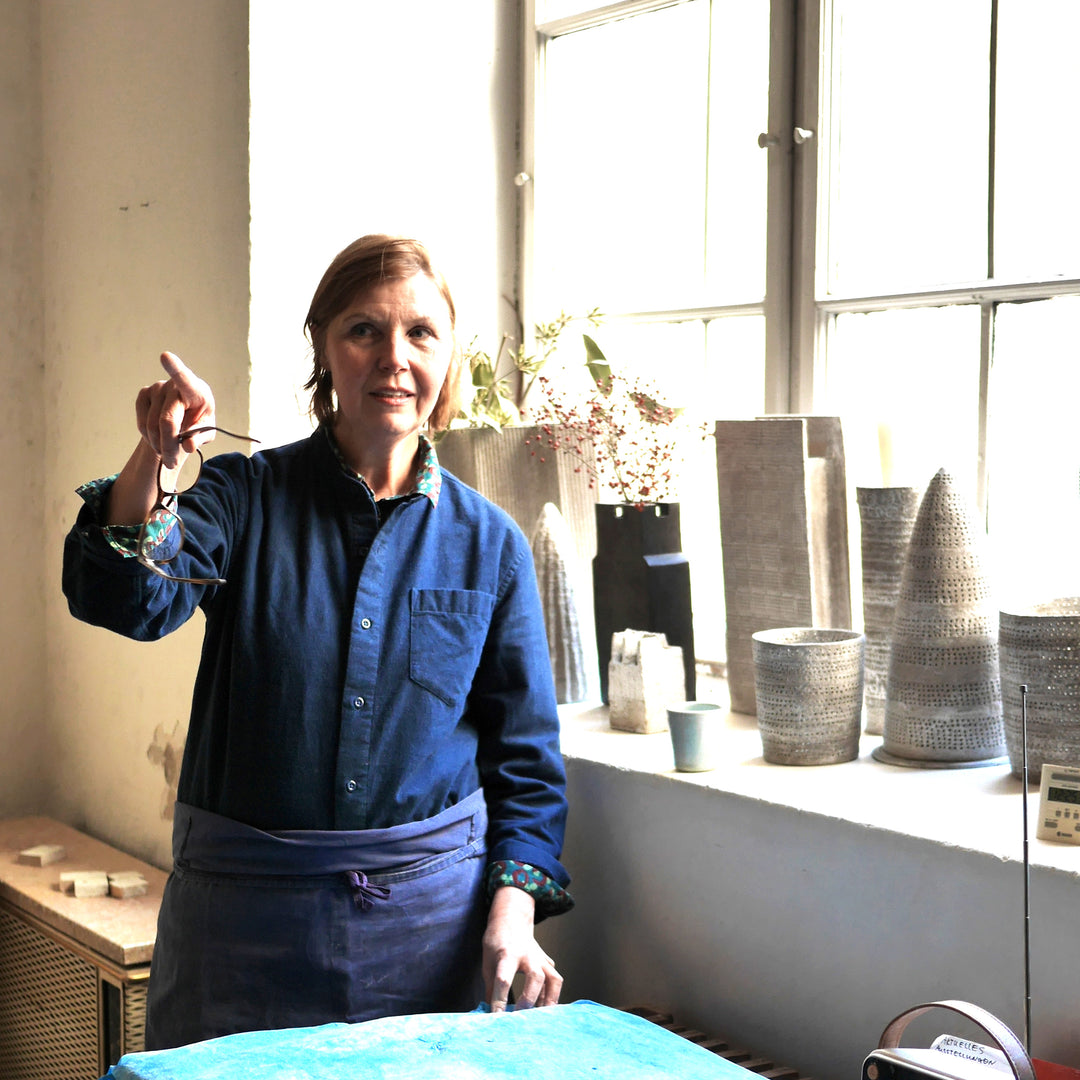
Christine Wagner's rough ceramics have an unmistakable character. She develops her object art from basic geometric shapes in an architectural manner and varies the vessel shapes through the different structures of the clay surfaces. She mixes the clay herself from red and beige mass from the Westerwald and refines it with surfaces made of metal oxides, kaolin and various white engobes.
The artist was born in Munich in 1959. She completed her ceramic apprenticeship with Yasoji Sasaki in Toki-shi, Japan, from 1980 to 1983. She then undertook study trips to Korea and China and continued her training in Landshut until 1985. In 1989 she received her ceramics diploma from the University of Art in Linz, Austria. Christine Wagner has been running her own studio in Munich since 1990. In addition to her artistic work, she has been teaching at the technical college for design in Karlsfeld since 2010 and in Unterschleißheim since 2014.
At first glance, her works appear unapproachable and straightforward. Those who allow themselves to be drawn into her restraint will discover the special features in the details. Delicate curvatures, subtle asymmetries and refined surface structures lend the objects vibrancy. Her ceramics reveal a subtle beauty that demands attention and refined senses.
Christine Wagner's excellent works are regularly exhibited and can be found in private and public collections, including Die Neue Sammlung in the Pinakothek in Munich and the Museum für Kunst und Gewerbe in Hamburg.