


About the object: Tomoko Iwata's vase is visually reminiscent of a pebble, but has a rough surface. This vase has a diameter of approx. 7.5 cm and a depth of approx. 5 cm. They are made of dark clay and irregularly stippled with a white glaze. These vases are part of Tomoko's single flower vase series "Kusana Utsuwa". The vase is waterproof and therefore suitable for both fresh and dried single flowers. Or small branches.
We offer reliable shipping for our products to various destinations. Here are our shipping options:
Germany:
EU countries:
Switzerland: Information regarding transportation costs to Switzerland can be found here.
Please note that the stated delivery times are estimates and may vary depending on the destination and current circumstances. We are always working to get your orders to you as quickly as possible.
For further information or special inquiries about shipping, please do not hesitate to contact us. to contact. We are happy to answer your questions.
- The vase should be washed by hand. Use clear water or at most gentle cleaning agents and no abrasive sponges.
- Dry the vessel carefully after cleaning to avoid water stains.
- Ceramic pots can be rougher on the underside than pots made of other materials. We therefore recommend protecting sensitive surfaces on which the jar is to be placed from scratching if necessary.
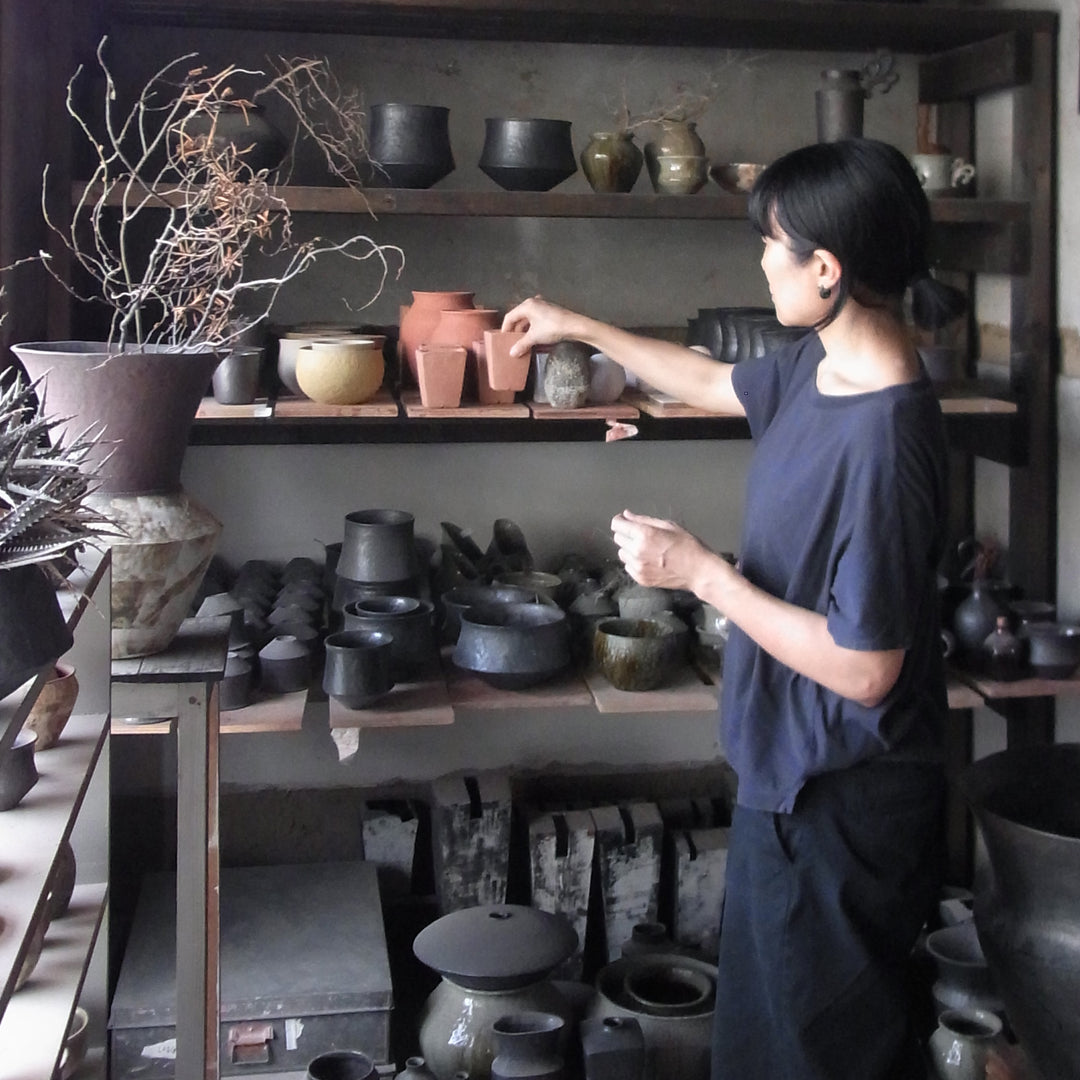
Tomoko Iwata, born in 1977 in Saitama, Japan, graduated with a BA in Fine Arts from Okinawa Prefectural University of Arts in 2000. In 2006, she completed her training at the Tokoname City Ceramic Art Institute and then set up her own business in Tokoname, Aichi. Since 2007, Tomoko has lived and worked in Gyoda, Saitama.
Tomoko Iwata works according to the Japanese concept of "Utsuwa" (beautiful things for everyday use). Her single flower vase series "Kusano Utsuwa" is made using the Tatara process. Tatara is a process in which clay slabs are formed by bending or joining them together on a board or flat surface. Tomoko Iwata uses tatara-zukuri to make her square, rectangular or trapezoidal vases from flat slabs of clay.
Their sophisticated designs often raise questions and astonish onlookers. Some vases look exactly like stones polished by the sea, others can be tilted in two different positions. And how is it possible for her cube-shaped vases to be glazed on all sides, even though the side that touches the kiln should actually remain unglazed?