About the property: Christine Wagner’s black stoneware vase captivates with its shimmering metallic surface and extraordinary shape. Its striking silhouette is reminiscent of a castle tower and highlights how the artist draws inspiration from architectural forms when designing her vases. Measuring approximately 24 cm in height, 9 cm in width, and 9 cm in depth, the piece appears both slender and expressive. The cross-shaped opening offers interesting possibilities for effectively showcasing individual branches or flowers. The clean form and deliberate focus on the essentials give this handmade, one-of-a-kind piece a special presence. An extraordinary vase that stands out as a work of art in its own right, even without floral arrangements.
Manufacturing Process: The shapes of Christine Wagner’s hand-built stoneware vases follow linear structures. Made from a coarse-grained clay she mixes herself, sourced from the Westerwald, the black surfaces are created by using a mixture of metal oxides such as manganese and various ochre earths. At high temperatures, the oxides melt to form an almost volcanic, metallic surface. The pieces are fired in a gas kiln under a reducing atmosphere. By depriving the clay of oxygen during the reduction firing at 1,280 degrees, Christine achieves a color spectrum in the fired clay ranging from light gray to beige or darker brown tones, depending on the clay mixture.
We offer reliable shipping for our products to various destinations. Here are our shipping options:
Germany:
EU countries:
Switzerland: Information regarding transportation costs to Switzerland can be found here.
Please note that the stated delivery times are estimates and may vary depending on the destination and current circumstances. We are always working to get your orders to you as quickly as possible.
For further information or special inquiries about shipping, please do not hesitate to contact us. to contact. We are happy to answer your questions.
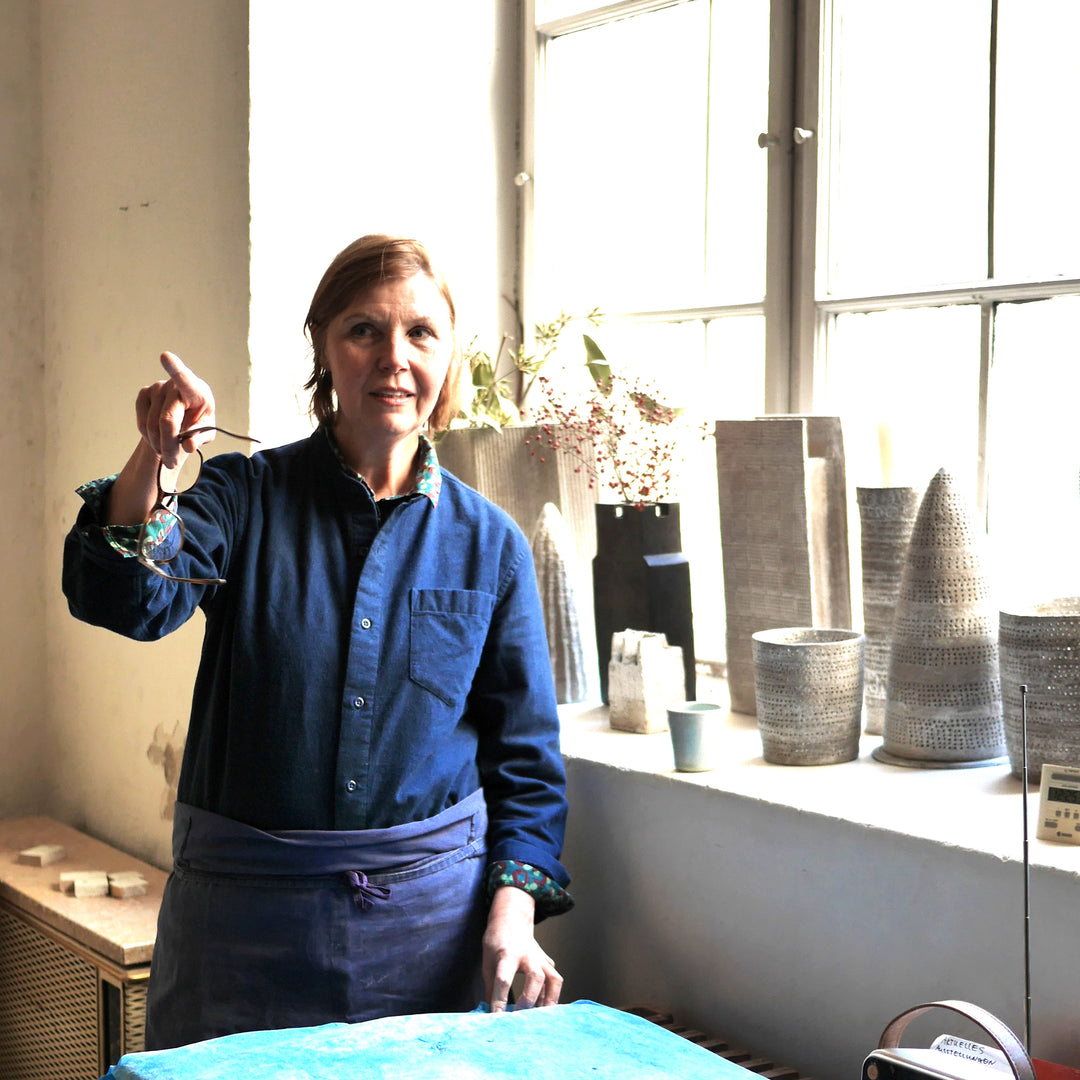
Christine Wagner's rough ceramics have an unmistakable character. She develops her object art from basic geometric shapes in an architectural manner and varies the vessel shapes through the different structures of the clay surfaces. She mixes the clay herself from red and beige mass from the Westerwald and refines it with surfaces made of metal oxides, kaolin and various white engobes.
The artist was born in Munich in 1959. She completed her ceramic apprenticeship with Yasoji Sasaki in Toki-shi, Japan, from 1980 to 1983. She then undertook study trips to Korea and China and continued her training in Landshut until 1985. In 1989 she received her ceramics diploma from the University of Art in Linz, Austria. Christine Wagner has been running her own studio in Munich since 1990. In addition to her artistic work, she has been teaching at the technical college for design in Karlsfeld since 2010 and in Unterschleißheim since 2014.
At first glance, her works appear unapproachable and straightforward. Those who allow themselves to be drawn into her restraint will discover the special features in the details. Delicate curvatures, subtle asymmetries and refined surface structures lend the objects vibrancy. Her ceramics reveal a subtle beauty that demands attention and refined senses.
Christine Wagner's excellent works are regularly exhibited and can be found in private and public collections, including Die Neue Sammlung in the Pinakothek in Munich and the Museum für Kunst und Gewerbe in Hamburg.